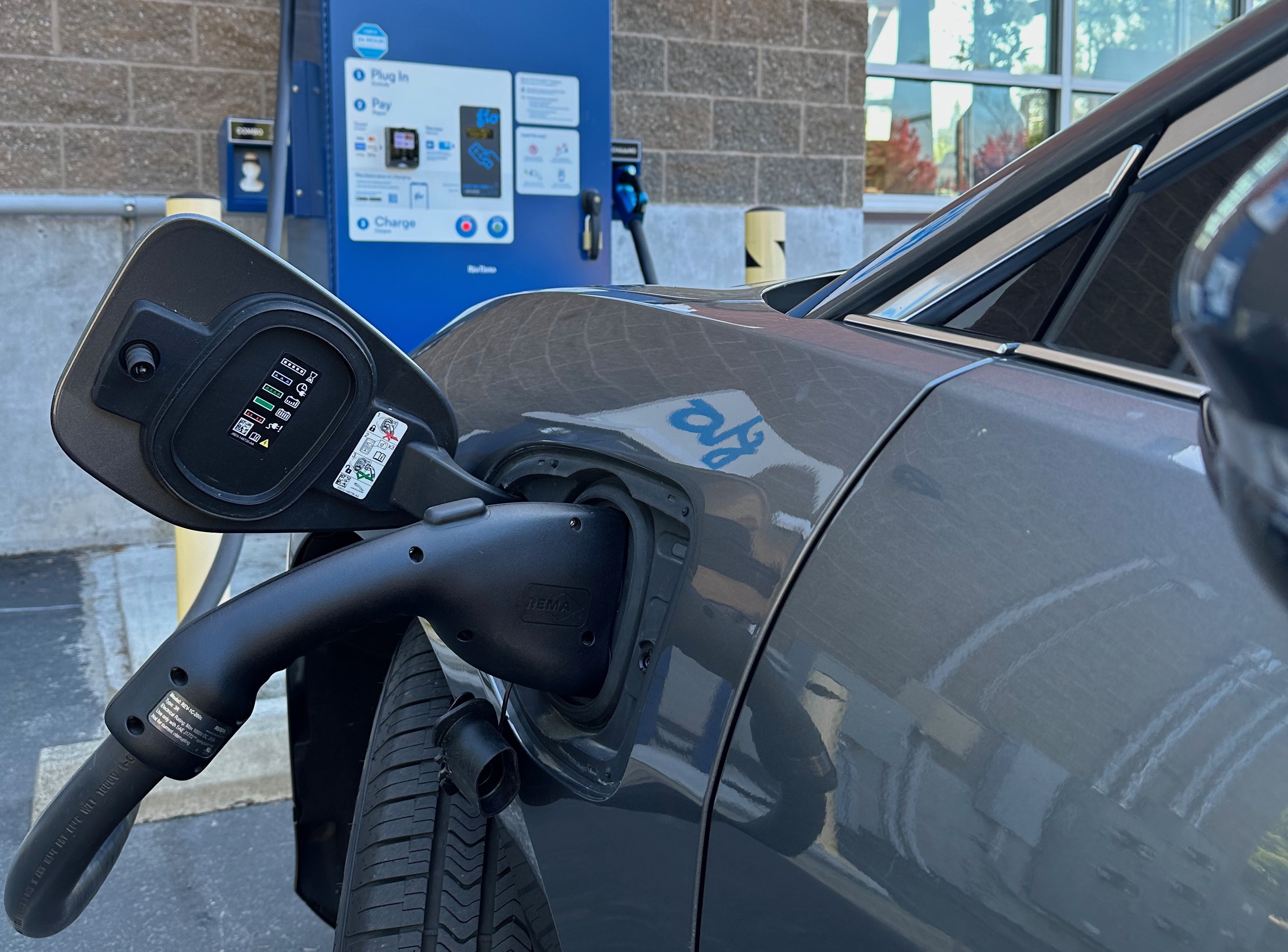
Electric cars generate a lot of passion. Like pretty much everything, nowadays, divisions run deep. I happen to believe climate change is a very real and very significant threat to our survival (probably lost a lot of readers there) but I’m not here to make an environmental statement. This blog is about finances so I’m here to talk money. Specifically, I think EVs can play a role in reducing financial risk.
Let’s face it, cars are expensive. Cars are often paid for via loans, which means recurring monthly expense with interest. Cars depreciate, making them poor assets to hold over time. Fuel costs rarely go down. And who hasn’t been slammed with an unexpected, out-of-warranty repair bill? To be blunt: cars are money pits.
The thing is, we have convinced ourselves that cars are essential (even when they’re not). They represent freedom and adventure. We drive them even when we don’t need to or, worse, when we shouldn’t. So, it’s not realistic to make a financial plan that doesn’t account for some kind of car. The question is, what kind of car represents the lowest financial risk?
That question led me to consider an electric vehicle, or “EV”. I’ve had some kind of gas-powered (or “ICE”) car since I was sixteen. I’ve loved (almost) each and every one of them, perhaps none more than my 2009 Jaguar XF. I bought it used for half of what it would have cost new, even though it was in mint condition, less than two years old hence under warranty, and had barely 12k miles on it. I’ve driven more than 60k miles over the thirteen years I’ve had it, and it has been glorious. Until it wasn’t.
Earlier this year my XF started acting up. I replaced the supercharger assembly which was gobsmackingly expensive. Then it started having problems keeping the battery charged. When it failed to turn over at the start of a recent commute – and wouldn’t jump even when attached to a tow truck – I knew the end was near. I couldn’t justify pouring dollar after dollar into a car I couldn’t rely on. And that’s not even considering how much gas it burned at 15mpg average. It was time to move on.
With retirement on the horizon, I wanted to pick a car that would cost less to drive and less to maintain. I don’t want to be on a fixed income and get hit with some astronomical bill just to drive around town. I knew EVs had substantially fewer moving parts and, as a resident of the Pacific Northwest, I knew electricity was ridiculously cheap. I found a used electric Jaguar at a great price, and it’s now my daily driver. Costs have been much, much lower. Whereas I shelled out $0.50 per mile in the XF, I’m now paying $0.05 per mile in the electric I-Pace – and it’s not even a very fuel-efficient model. While I will miss the XF when time comes to sell, I don’t think I’ll regret making the switch.
Which got me thinking: why is it that some folks just hate electric cars? We’ve seen the placards, the vandalism, and the vitriol spilled across the tee-vee and internet. One fellow even shared his concern that EV batteries would cook his balls. I mean, it’s just an engine. What is up with that? I thought picking a car was a math problem, not a social one.
I’m not going address any of the marginally informed myths out there (see CNBC for some great and informative content on the broader topic). Neither will I defend the very real problems found in battery manufacture; we need to do better (for all our energy needs). Those are all deep and interesting topics but, as I said, this is a finances blog. So, let’s do some math.
Comparing Fuel Costs
Per-mile fuel cost is the one, enduring constant regardless of what kind of car you drive. I’d argue that, while it shouldn’t be the only factor you compare, it’s a great place to start. The challenge is that costs aren’t consistent across vehicle types or state lines. For example, in Hawaii, electricity is almost $0.42/kWh while an average gallon of regular gas costs nearly $5. Comparatively, in Mississippi, you’d spend $0.14/kWh for electricity or $3.22 for a gallon of regular gas.
Then there’s the vehicle type. What if you already have a fuel-efficient ICE car? What if you want your next car to be an upgrade, using cheaper electricity to make a larger car more affordable? It’s rarely apples-to-apples when comparing cars so, I thought, it might be interesting to look at this from a few different perspectives.
In the following comparisons I will contrast the per mile cost based on either the stated miles-per-gallon or miles-per-kilowatt-hour (as listed on FuelEconomy.gov). I’ll use Kelly Blue Book (KBB) to pick vehicles, limiting selections to popular models from well-known brands (sorry, no Lucids or Lamborghinis here). Finally, for dollars, I’ll use the US Energy Information Administration for electricity costs, and GasBuddy.com for gasoline prices. Total costs will be based on an average of 13,489 miles driven per year[1] and an acknowledgment that per mile cost will vary based on your driving style – for both ICE and EV. So it’s ballpark and not precision.
There’s a ton of stuff I won’t be comparing: model pricing, available options, depreciation, maintenance, licensing fees and taxes, or insurance. These are valid factors but they’re wildly variable based on manufacturer, state of residence, current market conditions, and etcetera. For the purposes of this comparison, it’s just cost per mile.
Average to Average
The broadly applicable example would be to compare the average ICE versus the average EV. For model years 2023/24 the average combined MPG for cars was 31.58mpg[2]. An average gallon of gas costs $3.80 so the easy math here is [gallon of gas] ÷ [miles per gallon] = cost/mile or [$3.80] ÷ [31.58] = $0.12/mile.
Electric cars, on the other hand, average approximately 2.7 mi/kWh[3]. The average cost for a kWh in the US is $0.168. Again, simple math to get cost per mile: [cost of kWh] ÷ [miles per kWh] = cost per mile. Hence [$0.168] ÷ [2.7] = $0.06/mile.
Average to average, ICE fuel costs twice as much as EV fuel: $0.12 to $0.06 per mile.
But averages don’t capture location-specific circumstances. Remember Hawaii, where gas averages $4.85/gallon and electricity runs $0.4174 per kWh? How do these average cars stack up in paradise?
- Gas: $4.85 ÷ 31.58 = $0.15 per mile
- Electric: $0.4174 ÷ 2.7 = $0.15 per mile
So, in Hawaii, our average cars are tied. The thing is, in Hawaii, everything is more expensive. Mississippi has the least expensive gas in the United States at $3.23 per gallon. Electricity is also cheaper at $0.1346 per kWh. How do our average cars shake out here?
- Gas: $3.23 ÷ 31.58 = $0.10 per mile
- Electric: $0.1346 ÷ 2.7 = $0.05 per mile
Advantage, electric.
How about a state, like Washington, where electricity is extremely cheap at $0.1121 per kWh. A state where a gallon of regular gas costs $5.00 on average.
- Gas: $5.00 ÷ 31.58 = $0.16 per mile
- Electric: $0.1121 ÷ 2.7 = $0.04 per mile
Big advantage for electric in the Evergreen State. No surprise that’s why I went this way on my last car purchase.
Except for Hawaii and Connecticut, nearly all states see some cost savings (although the northeastern states seem to see the least). In many states the cost to fuel electric cars beats ICE vehicles by wide margins. On the surface of it you can see the appeal.
All of this assumes you are charging your car from home. If you are 100% reliant on the commercial charging network, you can expect to pay three to four times the at-home cost. Unless you live in the western United States, it’s pretty important you charge your EV at home if you want to realize that per-mile cost advantage.
Best to Worst Case: living large
What if you’re already driving a fuel-efficient ICE but you’d like to switch up to a larger EV, perhaps a luxury EV?
Kelly Blue Book lists the 2024 Mitsubishi Mirage as the most fuel efficient ICE available and, at an average 39mpg, it certainly sips very little gas when zipping from point a-to-b.
Comparatively, the deluxe Audi Q4 e-tron quattro, averages 2.77 miles per kw/h. While there are more luxurious models out there and some with far worse mileage, I believe Audi represents a brand more likely to be found in an American garage (as opposed to something like my Jaguar).
Let’s compare these cars using the above scenarios: United States average, Hawaii, Mississippi, and Washington state:
| Vehicle | Cost / mile Avg | Hawaii | Mississippi | Washington |
| Mitsubishi Mirage | $0.10 | $0.12 | $0.08 | $0.13 |
| Audi Q4 e-tron quattro | $0.06 | $0.15 | $0.05 | $0.04 |
Unless you’re living in Hawaii (where you might consider installing solar to reduce costs) going large actually costs less. And, even in Hawaii, it’s hard to ignore the change in vehicle class and capability. It might be worth a few extra pennies to drive an Audi over a Mitsubishi.
Best to Worst Case: getting economical
What if you’re looking to scale down? Perhaps you’re driving a large, gas-hungry ICE SUV. Would you really save a lot switching to the most efficient EV on the market?
The 2023 Jeep Grand Wagoneer offers luxury and utility and comes in at 17/MPG. Alternatively, you could swap in a Cadillac Escalade or Lincoln Navigator; mpg stats are relatively similar (although not quite as good as the Jeep).
The most energy-efficient EV? The Tesla Model 3 comes in at staggeringly good 4mi/kWh (although the Chevy Bolt comes in close at 3.7 mi/kWh).
How do these compare using my comparison setup?
| Vehicle | Cost / mile Avg | Hawaii | Mississippi | Washington |
| Jeep Grand Wagoneer | $0.22 | $0.29 | $0.19 | $0.29 |
| Tesla Model 3 | $0.04 | $0.10 | $0.03 | $0.03 |
In this comparison, the Tesla just swamps the Jeep. What is particularly surprising in this comparison is the two models are much closer in capability than my previous “living large” example. If you really needed a third row, Tesla offers the less efficient Model X, which is only delivers around 3.0 mi/kWh – still enough to win comparatively:
| Vehicle | Cost / mile Avg | Hawaii | Mississippi | Washington |
| Tesla Model X | $0.06 | $0.14 | $0.04 | $0.04 |
But what about …
Range anxiety, day to day?
None. Charging up is easy and, in hindsight, far preferrable to gas stations.
On average Americans drive about 30 miles per trip, perhaps a few days a week. For the most part, charging will be done at home. With most EVs capable of at least 250 miles, drivers will charge twice a month at best. Folks who drive in excess of 200 miles a day would clearly need to recharge nightly. But, with at-home charging, there is no anxiety as filling up your “tank” is as easy as plugging in a toaster.
It gets a little more challenging if you rely solely on commercial charging networks (like Electrify America or ChargePoint). Not only will these chargers be much more expensive, but availability and reliability are not guaranteed. Cities offer widespread access to commercial chargers but, sadly, rural areas are not as well covered.
Whether you live in a rental or own your own home, get a home charger. If that’s entirely impossible, consider blossom.ev as an alternative to commercial networks. If you have no other choice, try parking overnight at a low-wattage, type 2 commercial charger (avoiding DC Fast Chargers). They’re often easier to find and typically less expensive. Another tip is to look for chargers at grocery stores and shopping centers. Both offer great opportunities to charge while taking care of regular tasks.
No matter what the situation you’ll find you only need to charge a few times a month and that, once you get the rhythm down, it’s just another errand you incorporate into your life.
Range anxiety, big road trips?
On average we Americans take one road trip per year, typically under 500 miles round trip, usually to a nearby beach. Highways are dotted with DC Fast Chargers that add a lot of miles in around thirty minutes, giving you time to grab a coffee and stretch your legs. Given current EV ranges are around 250mi, chances are you’ll only need to stop once to recharge on your trip.
Like with any road trip, planning is key. Google, Apple Maps, and often your onboard car navigation system all have tools to help drivers plan their journeys. Check to see if your destination offers EV charging (many do). Identify commercial chargers along the way and make sure you’ve downloaded and set up the appropriate app. A little prep work makes most of the anxiety goes out the window.
Battery Replacement
Twenty years ago, batteries didn’t last very long. Today, however, they’re Federally mandated to offer 8-year warranties at minimum. Hit up eBay and you’ll find 10-year-old Teslas with more than 100k miles boasting batteries capable of holding 90% of their original charges. It’s hard to find ICE cars that have aged that well.
The thing is, batteries are built to last. So much so that battery recyclers are starved for product. This will change as more EVs hit the road. And, when they do, we’ll see increased availability for reconditioned batteries – just like we see with ICE parts today. It may be too soon to say but I expect, when the time comes to replace my battery, the costs will be much lower than the expense of replacing my supercharger assembly. And I’ll have a nearly new car as a result!
The Grid
Lots of concern centers around where we get our electricity (lots of natural gas plants out there) and how it’s distributed. These are all legitimate concerns that we must face regardless of electric vehicles. Our grid is dangerously outdated and inefficient. We need to build up capacity simply because there will be a lot more people drawing a lot more power from things like HVAC and computing. EVs are the least of our concerns here.
Regardless, will electricity rates go up? Probably. Will they go up more than gas? My bet is nope.
Consider that the average gallon of gas was $1.59 in 2003. Today, that same gallon costs $3.80, representing an increase of 139% in the last twenty years. Electricity, on the other hand, has only seen an 89% increase over the same period (from $0.089/kWh in 2003 to $0.168/kWh in 2023). If that holds, gas will be $9 gallon ($0.28/mi) in 2043 while electricity will cost a little over $0.31 per kWh (~$0.11/mi).
While it’s hard to guess what will happen in the next twenty years the data – so far – suggests electricity will remain cheaper over time. Stability will be even more likely if we build a grid that doesn’t rely on finite sources of fuel like gas or coal.
The expense?
Yes, EVs are more expensive – but by less than most would believe. The problem is that cars have become expensive. The average car – ICE and EV alike – now exceeds $48k. Buyers can find EVs from Tesla, Hyundai, Chevrolet, and Nissan that are all under that average price. The Bolt EV, for example, starts at $26,500. Even the handsome Ioniq 6 sedan can be had for as little as $43k.
Can you find super expensive EVs? Sure. But you can find super expensive ICEs and the exceptions don’t make the rule.
The total carbon cost of EVs?
This isn’t a direct economic concern unless, like me, you worry climate change will have a long-term impact on economic development and market volatility. Still, for those who are curious if driving EVs are any better than driving ICEs, check out this article from David Reichmuth, senior engineer serving on California’s Zero Emission Vehicles regulation. Lots of cool charts. We like charts.
Hybrids?
Yes, they are viable options. Whether you go with a traditional hybrid (which improves overall mileage) or a plug-in (which allows you to drive in either electric or ICE mode), hybrids can deliver real value. However, hybrids still have transmissions, pistons, differentials, and all the mechanicals of a conventional gas engine. For me, fewer moving parts means fewer things to go wrong. In that context, hybrids don’t meet my risk mitigation criteria.
Hydrogen?
There is no available commercial infrastructure for hydrogen cars outside of California. If you never plan to drive your hydrogen car out of state, this might work. It wouldn’t work for my retirement plan hence not included in comparisons.
Green or e-fuels?
This has been little more than a promise for over a decade. E-fuel currently costs around $40 per gallon to make and isn’t likely to scale up to meet demand within my retirement timeframe (see this great video from Donut that covers Porsche’s efforts to produce e-fuel). Plus, again, I’d be exposed to ICE maintenance costs. And it does little to ameliorate environmental concerns in that you’re still burning something to power a car.
Conclusion
If you charge at home, drive the typical 13k miles a year with most of it spent within 30 miles of home, EVs are definitively cheaper per mile than their ICE equivalents. In fact, you could probably bump up a class or two and still save operational cost.
How much operational cost? Americans keep their cars for 8 years on average, driving them approximately 108k miles in that time. Using the average cost-per-mile from earlier in this post, it would cost nearly $13k to fuel an average car with gas to cover that mileage. The same average EV would cost $6,500 – half of the equivalent ICE cost. Having an extra $800 every year is no small bounty, especially in retirement. In my case, the delta was even bigger.
While I don’t have enough reliable data to say, for sure, that maintenance cost would be less, I do know you’ll never have to replace a transmission, header, or other ICE mechanical component. I know EVs use their brakes far less because they actually recoup energy when slowing down via regenerative braking. Some say EV tires wear down quicker but there have been conflicting reports on that, with some saying EV tires actually last longer. All of this suggests, to me, that I’ll be spending a lot less on maintenance. AAA and CarGurus seem to think so, too, adding another $330 to my annual savings.
A replacement battery could be anywhere from $6-10k. But that’s not too different than the cost of major ICE work, like replacing a transmission and/or engine components like the oft-mentioned supercharger. This kind of major repair should be accounted for in your budget, whether you own an ICE or EV car.
In the end it’s hard for me to ignore the math: EVs are cheaper to operate, cheaper to maintain, and likely a wash when it comes to major repairs. I could definitely use the extra $1k/year between fuel and maintenance. And I like the idea that, if I have to replace my battery, the rest of the car is likely very sound and sustainable for another 100k miles or more. Realistically, 200k miles would last drivers 65 and older 26 years, which is probably the duration of any active retirement. Sort of a dark observation, but such is the nature of retirement planning.
I get that EVs aren’t the obvious right choice for every lifestyle or location, but I would encourage folks to do the math to see if the car you buy might help make your life easier in more ways than one.
Sources
- Mileage: Average Miles Driven Per Year: Why It Is Important, kbb.com
- Car Selections:
- MPG and mi/kWh: FuelEconomy.gov
- Electricity Costs: Average Price of Electricity to Ultimate Customers by End-Use Sector, eia.gov
- Fuel costs: Average Regular Gas Price Comparison by State, gasbuddy.com
- Converter: Miles per Kilowatt-Hour to Kilowatt-Hours per 100 Miles Converter, inchcalculator.com
[1] Average Miles Driven Per Year: Why It Is Important, kbb.com
[2] Source: fueleconomy.gov, fuel economy data selecting gas powered engines, model years 2023-24, excluding all battery and hybrid electric vehicles
[3] Source: fueleconomy.gov, fuel economy data selecting electric powered engines, model years 2023-24, excluding all hybrid electric vehicles and those not currently available in the US (VinFast)
 superfoo kinguseless
A good post on electrical vehicles. Thank you 🌍🙏